Monday, November 30, 2009

A Child in the Fight: To Kill or Not to Kill

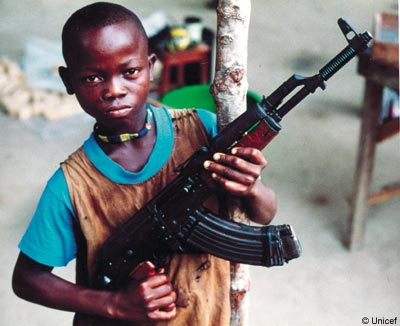
Today, I recently read the blog that is related to the ethical implications of using children to fight wars. There was a hatred of war in the city and it all started with this American soldier's experiences.

"As the adult moved back into the building, I saw him send a child of approximately 10 years out to retrieve the sniper weapon. The child scrambled toward the weapon, looked around, grabbed the weapon, and began his movement back to the rooftop door. I tightened my finger on the trigger of my sniper rifle as I sighted on the child moving toward the weapon. I knew the enemy must not get that sniper weapon into hands that would use it effectively against our Soldiers."

(http://usacac.army.mil/blog/blogs/cl/archive/2009/03/05/a-child-in-the-fight-to-kill-or-not-to-kill.aspx)


Wow, look at this sticky situation. The soldier had to think fast of choices to make. Should the soldier go ahead to shoot the child OR allow him to give the enemy a hand to kill one of our American soldiers with the sniper weapon? If you were a soldier, which choice would you make? If so, why? Please feel free to post the comment, thanks.

In my opinion, it is wrong to kill the child but at first, the soldier should do something to scare him off. If it is not working, then the soldier would not have any choice but to kill the child because he is our enemy. The soldier had to do it because it is his job to fight for his life and for others, too...

Tuesday, November 17, 2009

The Consequences of Child Labor

Forced child labor often have a huge impact on the health of children, well-being, their opportunity to become educated and literate, but instead they are often working for foreign companies, making things such as clothes, shoes, toys, and etc. for cheap labor for richer developed countries. Big companies decided to use children in poorer countries for cheap labor because the pay wages are so low so the richer countries save more money for labor. Also, the working conditions that the children are forced to work in is often terrible and not very clean.

Many of those child labors occur in third world countries such as African countries, Morocco, Brazil, Indonesia and many other countries that have to use children for labor to produce and export goods for cheaper labor costs for wealthy corporations in developed countries. What the wealthy countries took for granted, was made and worked on by children in other countries who worked until they could not work anymore.

Developing countries are not the only place where you can find child labor in sweatshops and factories. Child labor can be found in anyplace, especially right here in the United States. A statistics report made by U.S. Government Accountability Office (GAO) showed that about four million young teenagers between the ages of 15 and 17 are working in places like factories, even if the Supreme Court had made the decision to ban child labor in 1916. The statistics also showed that in the past decade, approximately more than 600 teenagers have been killed by accidents that happened while they were at work.

Currently, any knowledge of any business in developing countries that have forced child labor is being investigated because it breaks business ethics. Countries that are in the developing stage tend to include child labor, compared to the high rate of child workers working in factories in the United States and England during early 20th century. There are organizations that have been made to try to make child labor illegal worldwide. In 1995, International Labor Organization (ILO) made an estimate that there might be as many as 73 million child workers worldwide, working in extremely poor conditions. But in 1996 that number increased a lot more, and approximately 250 million children workers existed world wide, as reported by the ILC, including children between the ages of 5 to 14. Statistics also showed that Asia have the highest number of child workers than anywhere else in the World and that was nearly 14 years ago. If the number jumped from 73 to 250 million in only one year, imagine how many children are working in factories and sweatshops right now, compared to 73 million nearly 15 years ago.

References: http://www.springerlink.com/content/w808111676m5nl3m/ and http://samvak.tripod.com/childlabor.html
Wednesday, November 11, 2009

Donating Books for Illiterate Youth

The main purpose of the Global Literacy Project is to fund a project that dedicates its time and fund money to donate literacy-sponsored stuff and events for countries that are completely under-funded and have serious shortages on materials that are needed to educate their youth. This includes the use of books, textbooks, pencils, notebooks, spelling bees, math competitions, and workshops, all of which can help children and young adults develop their educational skills. The program supports and provides those materials and events to children of undeveloped countries that are often too poor to afford the best materials needed to educate their youth.

The Global Literacy Project, which stands for GLP, is a nonprofit organization that was established between 1999 and 2000. The organization is located in New Jersey to receive support from the community to help fund its goals to provide education to children around the world who need it the most. The goal of the Global Literacy Project is to reach out to children of either undeveloped or developing parts of the world, such as Africa, the Caribbean, and Southeastern Asia. The organization successfully sent approximately 17,000 books to Africa in the summer of 2000, and is setting up goals to do the same thing to help the children of the Caribbean and Southern Asian countries.

The article stated that the education and money needed to support education for the children is often either not enough or nonexistent in Africa or Southeastern Asia, where many people are forced to work to feed their family instead of going to school to receive an education that might change their lives. The schools there are based on the fundraising by the community itself, not by the government. The reasons for the high rate of undereducated in Southeastern Asia are because there are insufficient people who are qualified as teachers to teach the kids and not enough money to buy things necessary for school, such as textbooks, computers, and writing materials. In some cases, there are not enough textbooks for all of the students in the class, which means the whole class has to share one book in order to learn together. This shows how committed children in other countries are about an education that we in developed countries often take for granted.

Global Literacy Project. (2002-2009). Global Literacy Project, Inc. Retrieved November 10, 2009, from http://www.glpinc.org/Web_pages/Books%20for%20Africa,%20Asia%20and%20the%20Caribbean.htm#